Internet Democracy Project
From 2011 to 2021, the Internet Democracy Project worked towards realising feminist visions of the digital in society, by exploring & addressing power imbalances in the areas of norms, governance & infrastructure.

Towards an embodied approach to data
While dominant approaches tend to conceptualise data as a resource, simply out there and ready to be mined, in practice the nature and impact of data and data practices are often embodied - with important consequences for how data should be governed. Find our key contributions to this important debate now all in one place.
New research
Assessing account aggregators from a feminist perspective
Tripti Jain asks to what extent account aggregators address key criticisms of consent regimes today, thus facilitating and strengthening user consent and autonomy. She finds that while AAs represent some notable improvements, important weaknesses remain as further changes in the broader landscape, essential to their mission, remain absent.
-
Health Data as Wealth: Understanding Patient Rights in India within a Digital Ecosystem through a Feminist Approach

Over the past few years, there has been a drive towards the digitisation of healthcare in India. Policy frameworks in the country are incentivising further datafication by considering health data to be a commodity. In the context of big data, I argue that when health data is viewed as a disembodied resource, access to people’s health data becomes a form of power, giving those with such access the unparalleled and unprecedented power to influence the governance of people’s bodies and lives. Recognising the interconnections between our bodies and data from within an alternative feminist framework, this paper analyses the datafication of health in India through emerging developments proposed under the National Digital Health Mission (NDHM) ecosystem, and its implications for the bodies and rights of people. This work seeks to understand how datafication contributes to the disembodiment of health data in policy frameworks; the consequences of disembodiment for how people’s health data is understood to have value and who can benefit from that value, with a focus on health insurance companies; and how acknowledging the relationship between health data and bodies within policy frameworks can empower people to safeguard their right to equitable healthcare. More
-
What’s sex got to do with it? Mapping the impact of questions of gender and sexuality on the evolution of the digital rights landscape in India
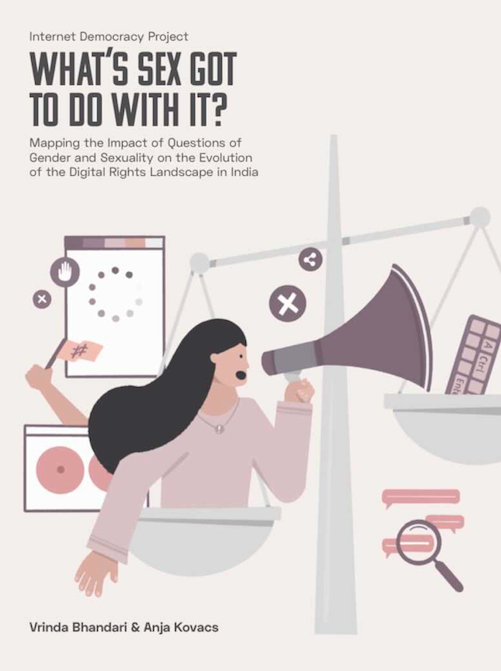

Taking as its starting point key High Court and Supreme Court cases in particular, this report seeks to map the many ways in which jurisprudence at the intersection of gender, sexuality, and digital rights has reduced, and at times expanded, digital rights in India. As our analysis will show, all too often, when it comes to digital rights too, anxieties surrounding women’s sexuality continue to justify court cases and jurisprudence that are geared towards protecting middle class morality and a very narrow vision of “Indian culture”, rather than gender and sexuality rights. Whether women are objects or subjects of state control, the negative effect on our digital rights is considerable. This is particularly true where the right to freedom of expression is concerned, but even the lopsided ways in which the right to anonymity and to be forgotten are evolving in Indian jurisprudence is deeply reflective of this dynamic. However, another way is possible. When courts put gender and sexuality rights front and centre, this report will show, possibilities to meaningfully exercise our rights immediately expand. More
-
Informed consent – Said who? A feminist perspective on principles of consent in the age of embodied data

While consent continues to be a crucial element of data protection regimes around the world, it has also been diagnosed with numerous weaknesses as a tool to promote and protect individuals’ autonomy. In this paper, we set out to learn from feminist theory around consent in general and feminist applied thinking around sexual consent in particular how consent regimes in data protection can be strengthened. We argue that such a journey will be promising because of the close entanglements between our bodies and our data. We particularly foreground feminist criticisms of the concept of “property in the person” to understand in more detail the profound harms that current data practices do to our personhood, as well as the ways in which consent is currently deployed to enable and even legitimise such practices, rather than challenge or reject them. Through close engagement with feminist thinking around consent, we then develop a list of feminist principles that will need to be followed if consent is to ever be meaningful in data governance. Finally, we outline three areas of change that the application of these principles immediately points to: changes related to the collection of data; changes related to the uses of data; and changes required to protect people who are especially vulnerable in particular. Making these shifts, we argue, is essential if we are to put into place a data infrastructure that is actually empowering for, rather than exploitative of people. This paper was first published by the Data Governance Network. More

COVID-19 From the Margins
Fighting a pandemic is considered
a legitimate aim of surveillance under international law. But how to
make sure that surveillance measures such as those implemented to combat COVID-19 target the disease, or the virus, and
not people? And how to ensure that marginalised people, in particular, are not affected disproportionately? Find our research, other initiatives, and recommendations on this topic here.
Analysis, opinion and other updates
-
Your health data is others’ wealth
Access to people’s health data holds the power to influence the governance of their bodies and lives, explains Radhika Radhakrishan in this essay that was first published by the Heinrich Böll Stiftung in Delhi on 2 November 2021. Read it below, or on the HBS website if you’d like to see the accompanying images as well! More
-
Our work on bodies and data is featured on The Swaddle. Watch the videos and listen to the podcast here!
Dr. Anja Kovacs, Director of the Internet Democracy Project, was interviewed by The Swaddle, on reimagining the Internet and the political economy of data. In a conversation with Shrishti Malhotra, Producer at The Swaddle, she discussed using the feminist idea of consent to prevent data misuse, how anonymity can empower women online, and why we need to reimagine how data governance works. The Swaddle turned the interview into three short videos and an hour long podcast. Check them all out here. More
-
Aarogya Setu: Mandatory or not? We traced it for eleven months through our Tracker
We traced whether Aarogya Setu was mandatory or not during the last 11 months from 8 May 2020 to 1 March 2021. The government claimed it wasn’t, but practice seemed to play out differently. Here is what we found. More
Gendering Surveillance
Although the digital age may have further deepened it, women have always been under stringent surveillance — whether by family, community or state. And this has shaped, and harmed, women’s lives in multiple ways.
This research project therefore asks: what
can be learned about surveillance from gendering it? And what do
these insights imply for the fight for stronger human rights protections
in the face of surveillance more broadly?
Latest policy work
Safeguarding patient rights within a digital ecosystem
In the age of big data, access to people’s health data gives those with such access unprecedented power to influence the governance of people’s bodies and lives. How can we safeguard patient rights in this context? Using a feminist framework, this policy brief by Radhika Radhakrishan provides 15 recommendations.
-
Strengthening the account aggregator ecosystem: A feminist perspective — A policy brief
In earlier research, Kovacs and I (2020) identified six feminist principles to strengthen consent in data governance. An examination of the account aggregator (AA) ecosystem against these principles makes clear that the AA framework is a positive step towards addressing some of the key concerns regarding current consent regimes, for example where auditability and granularity are concerned. However, to fully meet the minimum requirements necessary to ensure meaningful consent, further modifications will be needed. In particular, it appears that the focus of the ecosystem currently is on ensuring that AAs are robust, but that it fails to address challenges relating to other stakeholders in the ecosystem. More
-
Informed consent — Said who? A feminist perspective on principles of consent in the age of embodied data — A policy brief

Consent continues to be a crucial element of data protection regimes around the world. However, as a tool to promote and protect individuals’ autonomy, it has been diagnosed with numerable weaknesses. While there have been suggestions that it is therefore time to move away from consent altogether, we propose a different approach. Data protection regimes first need to reconceptualise the nature of data, by recognising the need to centre bodies in debates on data governance. Once the entanglement between bodies and data has been acknowledged, data governance regimes can, then, adopt feminist principles of consent that build on insights developed in numerous offline contexts and which allow us to imagine data relations that enable people to actually move closer to the ideal of meaningful consent. This policy brief was first published by the Data Governance Network. More
-
Protecting bodies and rights in disease surveillance during COVID-19 in India — A policy brief

Surveillance is increasing control over bodies of individuals, and the framework of data as a resource is facilitating this control, as illustrated here through the case of COVID-19 in India. Data governance frameworks view data as a disembodied resource, erasing its connections with people’s bodies and making surveillance seem innocuous. A feminist bodies-as-data approach enables embodied harms of surveillance to be pinpointed, and recommendations to be made to alleviate them. Drawing upon research of lived experiences of marginalised communities whose voices are often left out in data protection discourse, this policy brief proposes recommendations preserving not just data privacy, but bodily integrity, autonomy, and dignity of individuals. This policy brief was first published by the Data Governance Network. More

Don’t Let It Stand
How do you best address gender-based violence that you may face on social media? Our illustrated guide provides insights that can help.
Recent events
-
Participated in
The Love, Sex, and Data Conference
This conference is organised by the YP Foundation and Agents of Ishq. Dr. Anja Kovacs is giving a talk titled 'Keh ke Lunga: Data as an Extension of the Body'.
08 Oct 2021
-
Participated in
PrivacyNama
This conference is organised by MediaNama. Dr. Anja Kovacs is a speaker on the panel on bodies and data protection. The panel will discuss concerns around data collection related to bodies, the deployment of facial recognition systems, and how data protection laws need to address these concerns.
06 Oct 2021
-
Participated in
Understanding Body Politics in the Context of Big Data and Information Society
This event is the 35th Gender and Economic Policy Discussion Forum, organised by the Institute of Social Studies Trust in collaboration with the Heinrich Böll Stiftung. It is dedicated to understanding body politics through an intersectional feminist perspective focused on embodiment, as gadgets, technologies and media are increasingly becoming part of our bodies and policy and governance are more and more informed by ‘big data'. Dr. Anja Kovacs is a speaker.
31 Aug 2021
In the news
-
The Bastion
Internet, show me no more blues: Towards a feminist Internet
-
MediaNama
Rethinking consent and privacy in biometric data collection – #PrivacyNama2021
-
MediaNama
What impedes the effective regulation of biometric technology in India? #PrivacyNama2021
-
Indian Express
Delhi government shouldn’t congratulate itself on CCTV coverage
-
Input Magazine
'Song of Farca' lets you play in our coming data dystopia
-
The Swaddle
Pegasus surveillance is ‘deeply concerning’ for women who speak up against powerful men, activists say